

Pacific Behavioral Healthcare and Dr. James Olsen developed the Integrative Problematic Sexual Behavior (IPSB) Model to provide a more comprehensive and individualized way of understanding problematic sexual behaviors. Rather than assuming that the same diagnosis or treatment approach applies to everyone struggling with pornography, sexual behavior, or a sense of being out of control. The IPSB Model examines the unique factors that contribute to each person’s experience.
The IPSB Model
The model considers the range of psychological, relational, medical, and sexological factors that may influence problematic sexual behavior. This deeper understanding allows clinicians to move beyond the behavior itself and identify its underlying nature and function. Treatment can then be tailored to the individual rather than determined by a single label or predetermined model of recovery.
The IPSB Model has continued to evolve through the clinical and academic work of Pacific Behavioral Healthcare and Dr. James Olsen. That work is now taking another important step forward.
A new chapter, “An Integrative Model for Diagnosing Problematic Sexual Behaviors,” will soon be published in the Routledge volume Innovative Approaches to Out-of-Control Sexual Behavior: Beyond the Sex-Addiction Paradigm. The chapter represents the next stage in the development of the Integrative Problematic Sexual Behavior (IPSB) Model. A framework designed to help clinicians understand the many different pathways that can lead people to experience sexual behavior as problematic or out of control.
The premise behind the IPSB model is relatively simple, but it has significant implications for assessment and treatment. When someone comes to therapy saying, “I think I’m a sex addict,” the presence of distress, relationship consequences, or repeated difficulty controlling a behavior does not necessarily tell us what is causing the problem. Similar sexual behaviors can arise from very different psychological, medical, relational, and sexological processes. Effective sex addiction therapy, therefore, requires more than identifying the behavior. It requires understanding why it is occurring.
The new chapter develops the IPSB model into a more comprehensive framework for making those clinical distinctions. As the chapter explains, problematic, compulsive, or out-of-control sexual behaviors are not, by themselves, sufficient evidence for an accurate diagnosis. The goal is to move from simply describing the behavior toward understanding the pathways that produced it.
Moving Beyond a Single Explanation for Problematic Sexual Behavior
The sex-addiction model has played an important role in bringing attention to people who experience significant problems controlling sexual behavior. It has provided many clients with language for describing their experiences and has proposed sexual-addiction Diagnostic criteria. This has demonstrated clinical relevance among some treatment-seeking populations (Carnes et al., 2014). At the same time, organizing a broad range of problematic sexual behaviors around a single addiction construct creates an important limitation. Behaviors that look similar on the surface may have very different causes.
Contemporary diagnostic thinking increasingly recognizes this complexity. Compulsive Sexual Behavior Disorder (CSBD) is classified in ICD-11 as an impulse-control disorder rather than a disorder due to addictive behaviors. Its diagnostic guidance also requires clinicians to consider whether sexual behavior is better explained by another mental or medical condition, substance or medication effects, or distress arising entirely from moral judgments about sexuality (Kraus et al., 2018).
Even that differential diagnostic framework may not capture all of the relevant possibilities. Briken and Turner (2022), for example, have argued for greater attention to the specifically sexological dimensions of compulsive sexual behavior. The new IPSB chapter builds on this broader direction in the field by providing clinicians with a framework for examining a wide range of possible contributors. Rather than beginning with a predetermined explanation.
What Is the IPSB Model?
The Integrative Problematic Sexual Behavior Model is a framework for conceptualizing sexual behavior problems and assisting with differential diagnosis. Instead of beginning with the assumption that a client has an addiction or another particular disorder, IPSB begins with the problematic behavior and asks what combination of factors may be contributing to it.
The model recognizes that sexual behavior is influenced by interacting affective, cognitive, psychological, medical, relational, sexological, and environmental processes. This means that problematic sexual behavior is better understood as a possible outcome of multiple pathways rather than evidence of one universal underlying condition. The chapter describes IPSB as a tool for conceptualizing both pathological processes, such as mania or OCD, and nonpathological processes, such as erotic conflict.
This distinction is central to the model. Sexual behavior can become problematic without sexual desire itself being pathological, and a person can repeatedly engage in a behavior without addiction necessarily being the best explanation. The clinician’s task is to determine what is happening for the individual client and then develop treatment around that understanding.
Understanding the IPSB Pathways Model
At the center of IPSB is the IPSB Pathways Model, which organizes the processes preceding problematic sexual behavior into five broad stages: affective cravings, available outlets, internal deliberative barriers, external barriers, and execution barriers. These stages are presented sequentially for conceptual clarity, although the actual processes influencing human behavior are more dynamic and interactive.
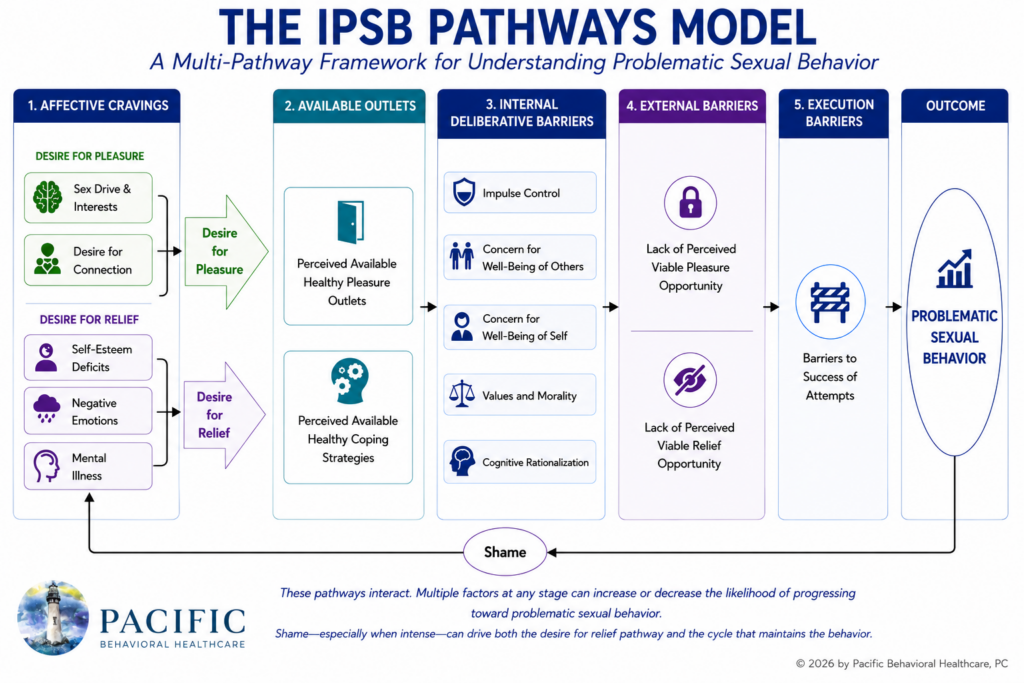
Figure. The IPSB Pathways Model. Adapted from Olsen (2024) and Olsen (forthcoming).
Affective Cravings: Pleasure and Relief
The model begins with two broad forms of affective craving: a desire for pleasure and a desire for relief. The desire for pleasure can originate in ordinary sexual drive and erotic interests or in a desire for intimacy and connection. The desire for relief can arise from negative emotions, self-esteem difficulties, mental-health distress, shame, or other painful internal experiences.
This distinction is important because many conceptualizations of problematic sexual behavior focus heavily on sexual behavior as a coping mechanism. Research supports the importance of coping and emotional regulation in many cases of problematic sexual behavior, but that does not mean that every problematic behavior is fundamentally an attempt to escape negative emotions. Human beings also have natural sexual drives, desires for pleasure, needs for connection, and diverse erotic interests. A comprehensive model needs to account for both pleasure-seeking and relief-seeking pathways.
Available Outlets
Affective cravings alone do not explain whether someone will engage in problematic behavior. The IPSB model next considers the person’s perceived available outlets for meeting those needs in healthy ways.
For someone seeking pleasure, this includes perceived opportunities for healthy sexual expression. For someone seeking relief, it includes perceived access to healthy coping strategies. Importantly, the model focuses on what the individual perceives as viable. A person may objectively have options available but not experience those options as realistic, satisfying, or accessible.
This concept also allows clinicians to consider the quality and variety of sexual outlets rather than looking only at sexual frequency. A person may have an intimate partner who is willing to engage in frequent sexual activity while still experiencing important erotic desires for which they perceive no viable expression within the relationship.
Internal, External, and Execution Barriers
The next stages examine what happens when cravings remain unmet. Internal deliberative barriers include processes such as impulse control, concern for the well-being of others, concern for one’s own well-being, values, morality, and the cognitive processes people use when making behavioral decisions.
The model then considers external barriers. Including whether the person perceives an opportunity to engage in the behavior, followed by execution barriers. These can affect whether an intended behavior can actually be carried out successfully. Together, these stages help explain not only why someone may be vulnerable to a particular behavior but also why that behavior may occur at a particular point in time.
Shame can also become part of a feedback process. Problematic sexual behavior can generate shame, which may contribute to additional emotional distress and an increased desire for relief. Sexual shame can operate differently. It can make healthy communication and sexual expression more difficult. Sometimes cause otherwise normative sexual behavior to appear compulsive to the individual or others.
Taken together, the pathways give clinicians a way to ask not simply whether someone is exhibiting problematic sexual behavior, but which processes are contributing to that behavior and where intervention may be most effective.
How the New Chapter Expands the IPSB Model
The new chapter takes the pathways framework and applies it more systematically to differential diagnosis. Clients presenting with problematic sexual behavior should be assessed across a broad range of possible contributing factors. Which is why the chapter recommends a comprehensive biopsychosocial sexual history rather than prematurely reinforcing a client’s self-diagnosis of “sex addiction.”
The chapter examines mental health conditions, including:
- ADHD
- Anxiety disorders
- Autism
- Bipolar disorders
- Depressive disorders
- OCD
- PTSD
- Personality disorders
- Substance-use disorders
- Sexual dysfunction
- CSBD
These conditions can influence different parts of the IPSB pathways. Some may increase sexual desire or the desire for relief, while others may interfere with healthy coping or sexual outlets, weaken internal barriers, or influence several of these processes simultaneously.
The differential diagnostic framework also extends beyond traditional mental-health diagnoses. Medical and neurological factors such as hormone levels, dementia, traumatic brain injury, dopaminergic medications, and several less-common neurological conditions can contribute to sexual behavior changes. The chapter also considers non-diagnostic struggles including relationship distress, shame, sexual shame, values conflicts, attachment difficulties, the love-lust split, and paraphilic interests.
The chapter illustrates the breadth of this approach by mapping diagnostic and non-diagnostic conditions according to how they may increase desire for pleasure or relief, decrease healthy sexual outlets or coping mechanisms, or reduce internal barriers. This provides professionals with a practical way of thinking about how very different conditions can produce behaviors that may look similar in the therapy room.
Why Differential Diagnosis Changes Treatment
Consider several clients who all report repeatedly viewing pornography after promising their partners that they would stop. From a behavioral standpoint, the cases might initially appear similar, and each person might arrive at therapy already convinced that the problem is “sex addiction.”
A closer assessment could reveal very different clinical pictures.
- One client might have developed a pattern of using sexual stimulation to regulate chronic negative affect.
- Another might have intense sexual shame and repeatedly commit to eliminating otherwise normative sexual behavior, interpreting each failure as evidence of addiction.
- Someone could be experiencing increased sexual drive and diminished inhibition during mania.
- A person with OCD might engage in sexual checking behavior in response to intrusive thoughts
- An individual might be struggling with significant relationship or sexual dissatisfaction and perceive few viable opportunities for healthy sexual expression.
- Another client might ultimately meet diagnostic criteria for CSBD.
Treating all of these presentations as manifestations of the same underlying addiction risks confusing a description of the behavior with an explanation for it.
More importantly, it can lead to treatment aimed at the wrong clinical target. The potential consequences of missed or incorrect diagnoses include shame, confusion, wasted time in treatment, and prolonged suffering while the factors actually driving the behavior remain untreated.
This is why differential diagnosis is not merely an academic issue. It directly affects what happens in therapy.
A More Comprehensive Alternative to an Addiction-First Approach
Integrative Problematic Sexual Behavior Model (IPSB Model) does not dismiss the reality that some people experience profound and persistent difficulty controlling sexual behavior. Rather, it provides a broader framework for determining why that loss of control is occurring.
An addiction-centered model begins with addiction as its primary organizing construct. IPSB takes a different approach by beginning without a predetermined etiological conclusion and examining multiple possible pathways before developing the case conceptualization.
This allows the framework to consider compulsivity, impulsivity, coping and emotion regulation, psychiatric symptoms, neurocognitive impairment, medication effects, high but nonpathological sexual desire, relationship dynamics, erotic conflicts, shame, values conflicts, limited healthy sexual outlets, and genuine CSBD within the same conceptual framework.
This broader approach also helps clinicians avoid pathologizing sexuality simply because it is intense, unconventional, or in conflict with a person’s values or relationship agreements. As the chapter notes, clinicians working with problematic sexual behaviors need to exercise caution about over-pathologizing sexual expression and should continue assessment even after identifying one plausible contributor because multiple factors are commonly involved.
For that reason, IPSB offers a more comprehensive conceptual framework than models that presume a single underlying addiction process. The relevant clinical question becomes not simply, “Does this behavior look like sex addiction?” but “What combination of processes best explains this person’s behavior?”
What This Means for Sex Addiction Therapy at Pacific Behavioral Healthcare
The continued development of IPSB has important implications for Pacific Behavioral Healthcare (PBH) and for people seeking treatment because they are worried that they have a sex addiction. Rather than requiring every client to adopt the same explanation for their behavior, an IPSB-informed approach allows clinicians to begin with a comprehensive assessment and develop an individualized understanding of the factors contributing to the problem.
For a client who says, “I think I’m a sex addict,” the clinician can explore what is driving the behavior, what function it serves, which needs the person is attempting to meet, what healthy outlets may be missing, and whether psychological, medical, relational, or sexological factors need further evaluation. Assessment can also examine the person’s internal barriers, sexual values, relationships, shame, erotic interests, and coping strategies before determining which treatment interventions are most appropriate.
This approach positions PBH to offer sex addiction therapy that reflects current developments in the understanding of problematic sexual behavior. The focus is not on minimizing harmful behavior or avoiding accountability. It is about making treatment more precise by directing intervention toward the factors that are actually maintaining the problem.
The publication of “An Integrative Model for Diagnosing Problematic Sexual Behaviors” further develops the theoretical and diagnostic foundation behind that approach and brings IPSB into the broader professional discussion represented by Innovative Approaches to Out-of-Control Sexual Behavior: Beyond the Sex-Addiction Paradigm.
For Pacific Behavioral Healthcare, the value is practical: continued development of the model can translate directly into more nuanced assessment, case conceptualization, and individualized care for clients.
Better Understanding Can Lead to Better Treatment
The central idea behind IPSB can be summarized in one principle: problematic sexual behavior is not an explanation in itself; it is something that needs to be explained. Two people can arrive at similar behaviors through very different pathways, and those differences matter when clinicians decide what to treat.
The forthcoming chapter extends this principle into a more detailed diagnostic framework, encouraging professionals to look beyond surface-level similarities and investigate the multiple conditions and circumstances that may contribute to sexual behavior problems. The goal is greater precision in assessment, greater caution with diagnostic labels, and treatment that is better matched to the individual.
People seeking help with sexual behavior problems deserve to have their concerns taken seriously. They also deserve an assessment that does not assume the answer before asking the questions. The IPSB model is designed to help clinicians do both.
Learn More
Learn more about the Integrative Problematic Sexual Behavior (IPSB) Model and Pacific Behavioral Healthcare’s approach to sex addiction therapy at the Pacific Behavioral Healthcare website.
Innovative Approaches to Out-of-Control Sexual Behavior: Beyond the Sex-Addiction Paradigm is forthcoming from Routledge.
Contact Pacific Behavioral Healthcare
Pacific Behavioral Healthcare provides in-person therapy in Seattle and Bellevue, WA. As well as, secure online therapy throughout Washington State, and telehealth in participating PSYPACT states.

About the Author:
Dr. Shira Olsen, PhD, LPsy, CST, CCPS, DST Director of Betrayal Trauma Therapy | Pacific Behavioral Healthcare
Dr. Shira Olsen is a Washington State-licensed clinical psychologist, PSYPACT-registered Psychologist, and Certified Sex Therapist at Pacific Behavioral Healthcare. She has extensive clinical and research expertise in sexuality, trauma, and intimate betrayal. Dr. Olsen co-developed the Posttraumatic Growth Model for Intimate Betrayal (PTG-IB), an innovative trauma treatment designed to help clients heal after betrayal trauma.
References
Briken, P. (2020). An integrated model to assess and treat compulsive sexual behaviour disorder. Nature Reviews Urology, 17, 391–406. https://doi.org/10.1038/s41585-020-0343-7
Briken, P., & Turner, D. (2022). What does “sexual” mean in compulsive sexual behavior disorder? Commentary to the debate: “Behavioral addictions in the ICD-11.” Journal of Behavioral Addictions, 11(2), 222–225. https://doi.org/10.1556/2006.2022.00026
Carnes, P. J., Hopkins, T. A., & Green, B. A. (2014). Clinical relevance of the proposed sexual addiction diagnostic criteria: Relation to the Sexual Addiction Screening Test-Revised. Journal of Addiction Medicine, 8(6), 450–461. https://doi.org/10.1097/ADM.0000000000000080
Kraus, S. W., Krueger, R. B., Briken, P., First, M. B., Stein, D. J., Kaplan, M. S., Voon, V., Abdo, C. H. N., Grant, J. E., Atalla, E., & Reed, G. M. (2018). Compulsive sexual behavior disorder in the ICD-11. World Psychiatry, 17(1), 109–110. https://doi.org/10.1002/wps.20499
Miller, W. E., & Rosen, D. (Eds.). (2027). Innovative approaches to out-of-control sexual behavior: Beyond the sex-addiction paradigm. Routledge.
Olsen, J. P. (2024). The IPSB model for understanding and treating sexual behavior problems. Pacific Behavioral Healthcare.
Olsen, J. P. (forthcoming). An integrative model for diagnosing problematic sexual behaviors. In W. E. Miller & D. Rosen (Eds.), Innovative approaches to out-of-control sexual behavior: Beyond the sex-addiction paradigm. Routledge.